Casinos That Accept Dogecoin in the UK: What to Check
 Available in US
Table of Contents
- What the available evidence says about Dogecoin acceptance
- If Dogecoin is unavailable: established UK payment routes
- Deposits, minimums and promotion eligibility
- Mobile slots and the limits of payment-specific claims
- Real-money slot play: what can be verified
- Deposit and withdrawal costs are not the same calculation
- Bonus terms depend on the payment method
- Checking whether a small Dogecoin deposit is actually possible
- Comparing Dogecoin with other payment options
- Dogecoin casinos and GamStop: what the evidence does not establish
General references to cryptocurrency do not confirm Dogecoin support; availability must be checked in the account’s deposit options.
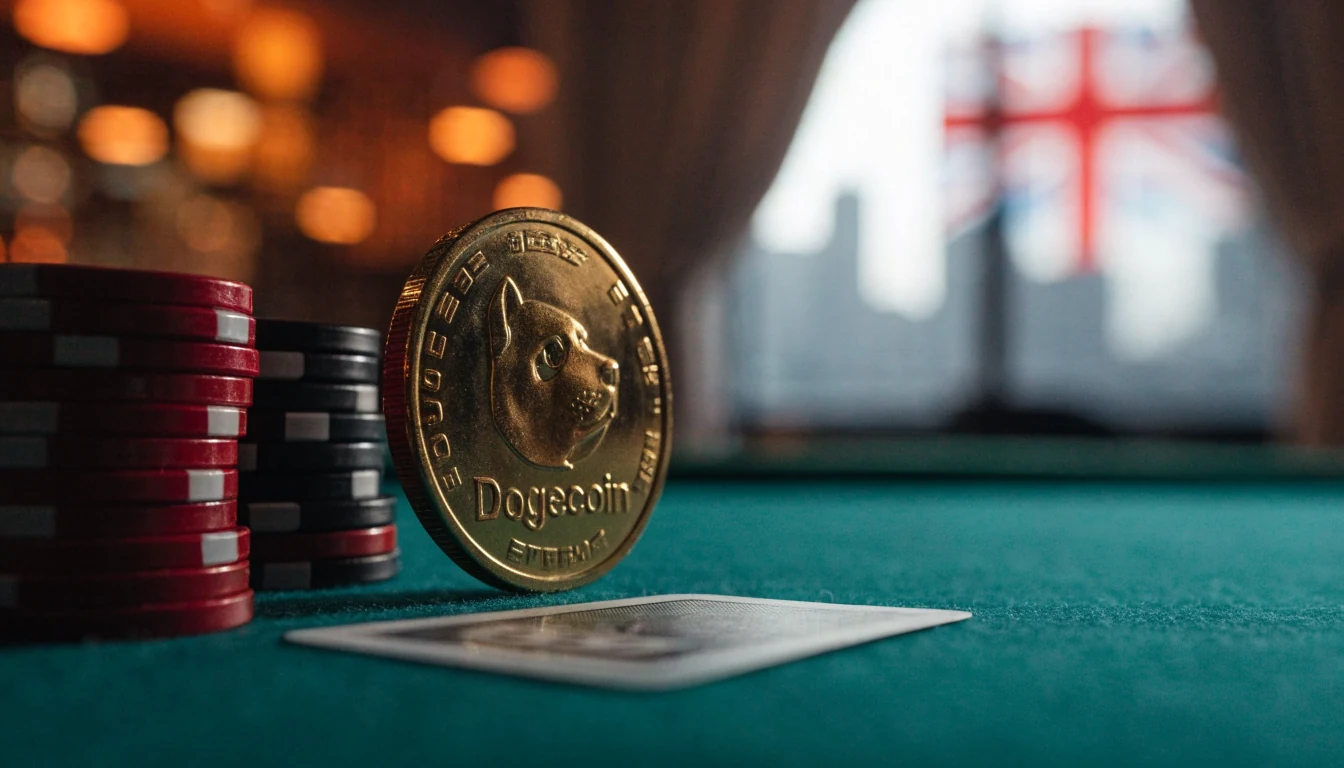
What the available evidence says about Dogecoin acceptance
A casino mentioning cryptocurrency is not the same as a casino confirming Dogecoin as a payment method. A specialist review of casino payment pages records references to several cryptocurrencies alongside Visa, Mastercard, bank transfer and e-wallets. That establishes only that cryptocurrency is discussed in the material. It does not establish that Dogecoin is among the currencies the cashier currently accepts, or that a Dogecoin deposit can be completed from a UK account.
That distinction matters because payment descriptions can be broad. A page may refer to “crypto” without naming each supported coin, or may describe a payment option without showing whether it is available to every customer. Even a named cryptocurrency on an information page is not, by itself, confirmation that the current cashier offers it. The practical test is whether Dogecoin appears as a selectable option for the specific account at the point of deposit, with the terms for that transaction visible.
The position can also differ between a casino’s general website and its cashier. A payment method listed in a review or on a general payment page may not be offered to a particular customer. The review may be dated, the operator may have changed its methods, or the account’s market settings may affect what is displayed. Those possibilities are reasons to check the live payment screen, not grounds to assume that a method works.
The same caution applies to card claims. A specialist review lists Visa and Mastercard among methods shown by the sites it examined, but current UK availability and eligible card products still need to be confirmed in the cashier. A logo or brand name does not settle the details of a particular transaction. It is therefore a weak basis for asserting that a casino accepts a specific card product in the UK; it is an even weaker basis for asserting support for a cryptocurrency that is not explicitly named.
Casinos That Accept eCheck in the UK: What to Verify
For Dogecoin, the distinction is between a general reference to digital currencies and direct evidence of a working Dogecoin route. Direct evidence would identify Dogecoin in the current cashier and make clear that the option applies to the account in question. A broad statement that a casino accepts cryptocurrencies does not meet that standard. Nor does a list of other coins establish that Dogecoin is included: one currency cannot stand in for another.
This is why a reliable answer to whether Dogecoin casinos remain available to UK customers cannot be built from cryptocurrency wording alone. A list based on that wording risks mixing confirmed payment options with assumptions. The same problem affects claims about newly launched sites, “best” choices, or casinos said to offer Dogecoin bonuses: those claims require operator-specific, current confirmation. No ranking can repair an unsupported starting point.
The UK regulatory position is a separate check. Remote gambling operators offering services to customers in Great Britain must hold the relevant Gambling Commission licence, regardless of where the operator is based. A cryptocurrency payment option does not alter that requirement. A casino’s payment page should not be treated as evidence that it is authorised to serve the British market; its operating licence can be checked on the Commission’s public register before a deposit is made.
A useful verification sequence is narrow. First, establish that the casino is licensed to serve the market. Then open its cashier while logged into the relevant account and look for Dogecoin by name, rather than relying on a general cryptocurrency label. Confirm that the displayed method is available for the account and that the transaction terms are shown before proceeding. If Dogecoin is absent, a broad crypto statement does not fill the gap.
The distinction is not semantic. A payment method needs to be usable in the actual account, not merely mentioned somewhere on a website. On the evidence available from general payment descriptions, cryptocurrency is a category that appears in casino material; Dogecoin acceptance is a more specific claim and needs its own confirmation. That is the basis for assessing any individual site, rather than assuming that every casino referring to crypto accepts Dogecoin.
- Check the live payment screen in the cashier while logged in
- Verify the casino holds a valid Gambling Commission licence
- Confirm that Dogecoin is explicitly named as a selectable option
- Assume a general mention of “crypto” includes Dogecoin
- Rely on outdated reviews or general information pages
- Treat a cryptocurrency logo as confirmation of availability
If Dogecoin is unavailable: established UK payment routes
When a casino cashier does not show Dogecoin, the established alternatives fall into four broad groups: debit cards, bank-based payments, e-wallets and prepaid vouchers. Their practical differences begin with how money reaches the casino account and whether the method can also be used for withdrawals. Availability is operator-specific, so a payment route documented across UK casino sites is not a guarantee that it appears at every cashier.
Debit cards are the most familiar route. UK casinos commonly accept debit cards carrying the Visa or Mastercard brands, subject to the operator’s current cashier options and the card product’s eligibility. That does not mean that credit-card payments for gambling are allowed: UK-licensed casinos cannot accept them. The distinction matters if a card account offers both credit and debit facilities; the permitted payment source is the debit function, not a credit balance.
Some UKGC-licensed casinos also offer Apple Pay for deposits. It is a card-based wallet route rather than evidence of cryptocurrency support, and its presence should be checked at the individual cashier. A payment logo on a general information page is not sufficient to establish that the method is available for a particular account or transaction.
Bank-based payments include bank transfer and open banking services. A specialist casino-payment review reports that these can support instant deposits and fast withdrawals at many sites. That is a description of the sites covered by that review, not a fixed service standard for every UK casino. The route may be presented as a direct transfer or through an open banking connection, with the available provider and transaction flow determined by the operator.
Casinos That Accept Litecoin in the UK: What’s Verified
The distinction between a bank route and an e-wallet is operational: the former connects the casino transaction to a bank account, while the latter uses a separate payment account. Neither category should be treated as interchangeable with Dogecoin. A cryptocurrency mention elsewhere on a site does not establish that Dogecoin is accepted, and a bank-payment option does not say anything about crypto support.
E-wallets include PayPal, Skrill and Neteller at sites where they are offered. A specialist casino-payment review describes PayPal as popular for speed and convenience, while noting that it may be excluded from bonus eligibility. The review’s observation should not be read as a universal rule: the cashier and the promotion’s own terms determine what applies at a particular casino.
Skrill and Neteller are also available at some sites. A specialist payment-method review reports that these wallets are often excluded from promotions, but that condition is not automatic across every operator or offer. Their main category-level difference from a prepaid voucher is that they are wallet accounts rather than codes purchased for a single deposit. Their availability, permitted use and any offer conditions still depend on the casino.
Wallet funding rules also matter. UK remote gambling operators cannot accept wallet payments where the wallet allows credit-card funds to be used for gambling. This is separate from whether a wallet brand is listed as a payment option: the source of funds and the wallet’s permitted arrangement affect whether the transaction can proceed.
Paysafecard is a prepaid voucher route. It is deposit-only, so it does not provide a matching withdrawal method. That makes it structurally different from a bank transfer or a wallet that the casino permits for both directions. The voucher can be considered only as a way to fund an account; it should not be mistaken for a complete deposit-and-cash-out arrangement.
Debit cards Commonly Visa or Mastercard; must be debit functions, not credit.
Bank-based Includes bank transfers and open banking services for instant deposits.
E-wallets Services like PayPal, Skrill, or Neteller; may have promotion restrictions.
Prepaid vouchers Such as Paysafecard; these are deposit-only methods.
For a UK player looking for alternatives to Dogecoin, the useful comparison is therefore by payment function, not by brand familiarity. Debit cards connect the casino payment to a card account; bank-based services connect it to a bank; e-wallets use a payment account; Paysafecard is a prepaid, deposit-only option. None of those categories confirms that Dogecoin itself is available.
Before depositing, the casino’s own cashier is the decisive check for the method shown, while the operator’s payment terms establish any restrictions attached to it. The same account holder should make the payment using a route registered in their own name. That keeps basic ownership details aligned and reduces avoidable friction if the casino needs to confirm who supplied the funds. For any UK casino, payment availability is a transaction condition, not a substitute for confirming that the remote gambling licensee is authorised to serve the British market.
Deposits, minimums and promotion eligibility
A deposit threshold is set by the casino and may also depend on the payment route. A specialist review reports a common UK minimum-deposit range of £10–£20, with the applicable figure varying by method. That is a guide to the range described by the review, not a confirmed minimum for every casino or for Dogecoin. The amount shown in the cashier is the operative condition: a general payment-method range cannot establish the threshold for a particular account or cryptocurrency.
The distinction matters where a promotion has its own qualifying deposit. The minimum needed to open a transaction may not be enough to qualify for an offer, and an offer’s terms may restrict which methods count. The deposit amount, payment method and promotion conditions therefore have to be read together. A low threshold does not, by itself, make a deposit eligible for a bonus.
Casinos That Accept Bitcoin in the UK: What to Check
Searches for Dogecoin casinos with no minimum deposit, free spins without a deposit or no-wagering offers describe different conditions, not a single product. “No deposit” concerns whether an offer requires an initial payment; “no wagering” concerns whether winnings are subject to a play-through condition. Neither label verifies that Dogecoin can be used at the cashier, that the offer is available to a UK account, or that its terms are as brief as its headline. No specific Dogecoin offer or threshold can be inferred from those descriptions.
Payment-specific eligibility can also change the value of an offer. A specialist review has reported that PayPal may be excluded from bonus eligibility. That is a warning to check the promotion’s stated payment exclusions, not evidence that every casino excludes it. The same principle applies to any method: an accepted deposit route and a qualifying promotion route are separate matters. If an offer excludes the method used, the deposit may still be credited while the promotional benefit is not awarded.
Before depositing, the relevant conditions are the cashier’s minimum for the selected method, the promotion’s qualifying amount and the list of excluded payment routes. Where the promotion requires a code or activation, that requirement also needs to be checked in its terms rather than assumed from the offer banner. A promotion described as free spins or a no-deposit bonus does not remove the need to establish its eligibility conditions.
Deposit Essentials
- Minimum deposit amounts vary by payment method and casino.
- A qualifying deposit for a promotion may differ from the standard minimum.
- Always check the specific terms regarding excluded payment routes.
- Verify the amount and method in the cashier before proceeding.
For a Dogecoin transaction, the deposit screen would need to identify the cryptocurrency as an available method and display the amount accepted for that route. A minimum stated for debit cards or e-wallets does not prove the same minimum applies to Dogecoin. Nor does the presence of a cryptocurrency reference in general establish that Dogecoin qualifies for a promotion. Payment availability and promotional eligibility are separate checks, and neither can substitute for the other.
There are also account conditions before money can be deposited. Remote operators must verify a customer’s age before accepting a deposit, and UKGC rules require a new customer to be prompted to set a financial limit before the first deposit. Account-level limit controls must remain accessible. These requirements sit alongside the casino’s own cashier and promotion rules; they do not establish a particular Dogecoin minimum or make an offer eligible.
The practical calculation is therefore not simply “minimum deposit versus advertised bonus”. It is the amount required by the chosen payment route, whether that route is accepted for the promotion, and any additional conditions stated for the offer. If one part is unclear, the headline figure cannot settle the terms.
Mobile slots and the limits of payment-specific claims
A mobile layout changes how a casino is displayed, not which payment methods its cashier accepts. A site may let players open slot games in a phone browser or app while offering a separate set of deposit options. The presence of mobile slots therefore says nothing by itself about whether Dogecoin can be used to fund play.
The same distinction applies to a payment button. A casino could mention cryptocurrency in general without establishing that Dogecoin is available, and a mobile page may not show the full cashier options before account access. Payment availability is an account-level detail, not a feature that can be inferred from the screen size or the games menu. Any claim about paying for mobile slots with Dogecoin needs to match the method actually presented in the casino cashier.
Casinos That Accept POLi in the UK: How to Check
“Free” play also describes a different arrangement from depositing cryptocurrency for real-money play. A free-play mode does not establish that a casino accepts Dogecoin, and a Dogecoin reference on a page does not establish that a particular slot can be played for cash. Those are separate claims and require separate evidence; combining them into a single promise would blur the transaction and the game.
Legality depends on the operator as well as the payment route. In Great Britain, remote gambling licensees serving customers must hold the relevant Gambling Commission licence. The Gambling Act 2005 governs England, Wales and Scotland, but not Northern Ireland. A mobile interface does not alter those requirements, and a cryptocurrency label is not a substitute for a UK licence.
Mobile access also does not remove the rules for online slots. Autoplay is banned in Britain, and each online slot spin must last at least 2.5 seconds. The maximum stake per game cycle is £5 for customers aged 25 and over; for those aged 18 to 24, it is £2. The £5 limit for all adults took effect on 9 April 2025. These restrictions concern slot play, not the currency used to make a deposit.
That separation matters when assessing a mobile casino’s claims. A listed slot, a working mobile game, a cryptocurrency logo and an available Dogecoin deposit method are not interchangeable evidence. The payment question is settled in the cashier; the rules governing slot play apply regardless of whether the site is viewed on a phone, tablet or desktop. A mobile-friendly label establishes only the presentation of the service, not its payment terms or regulatory status.
In Great Britain, autoplay is prohibited and each online slot spin must last at least 2.5 seconds. The maximum stake per game cycle is £5 for customers aged 25 and over, and £2 for those aged 18 to 24.
Real-money slot play: what can be verified
A real-money slot session involves two separate things: the casino account’s balance and the game played against that balance. A payment method, where offered, funds the account; it does not by itself establish that an individual slot accepts that currency or has a Dogecoin-specific version. The distinction matters when a site describes its cashier as supporting cryptocurrency: that wording is not evidence that its games are denominated in Dogecoin.
For British players, real-money casino play belongs within the UK’s regulated gambling framework. Remote gambling licensees serving customers in England, Scotland and Wales must hold the relevant Gambling Commission licence. A casino’s use of cryptocurrency language does not replace that requirement. The Gambling Act 2005 governs gambling in Great Britain, while Northern Ireland has a separate legal framework.
The legal conditions of slot play also apply regardless of how an account was funded. Operators must verify a customer’s age before permitting a deposit. Online gambling is legal for people aged 18 and over when the operator holds a UK Gambling Commission licence. Remote operators must prompt new customers to set a financial limit before their first deposit and provide account-level controls for managing limits.
Stake restrictions apply to online slots in Britain. The maximum stake per game cycle is £5 for customers aged 25 and over, and £2 for customers aged 18 to 24. The £5 limit for all adults took effect on 9 April 2025. Slot spins must last at least 2.5 seconds, and autoplay is prohibited. These are rules for the game, not features that change according to whether funds originated in pounds or Dogecoin.
Casinos That Accept USDC in the UK: Payment Checks
That leaves a narrow meaning for “playing slots for money with Dogecoin”: the casino would need to support Dogecoin in its account-payment process, and the player would need to use that funded balance on a real-money slot. Neither a slot’s title nor a general claim about a casino’s cryptocurrency options establishes both steps. A “free” game is a different product state from wagering real money; a real-money claim should be assessed against the operator’s terms and the account’s actual balance and currency.
The name of a slot, an app label or a promotional description is not enough to establish a Dogecoin-enabled game. The relevant distinction is whether the operator’s terms describe real-money play and whether the account and cashier support the stated currency. A general game catalogue can show what is available to play, but it cannot by itself establish the payment route or the currency in which a real-money balance is held.
For a UK-facing real-money casino, licensing status and game rules remain the controlling conditions. Cryptocurrency terminology does not create an exception to the stake limits, spin-duration rule, age checks or account controls. A product description that leaves the currency, licensing position or real-money status unclear does not settle those points.
Deposit and withdrawal costs are not the same calculation
A payment route can make a deposit look simple without making the eventual cash-out cheap or quick. The two transactions may pass through different checks, providers and conversion steps. A deposit confirmation therefore says little about the amount that will reach a bank account or how long the withdrawal will take.
Cost Uncertainty
Attention A visible flat fee is not the total cost; exchange-rate spreads and network charges can significantly impact the final amount.
A specialist review describes card deposits as potentially instant while a payout may take several business days. That is a reported comparison, not a timetable that applies to every casino or account. Withdrawal processing can include the casino’s approval stage, and a first withdrawal may take longer while KYC is completed. The time shown for a payment method should be read alongside the operator’s processing conditions, not treated as the whole journey.
Cost is also a chain rather than a single fee. Depending on the route, charges may come from the casino, the payment provider, a bank or card issuer, currency conversion, or a cryptocurrency network. A specialist review notes that the exchange-rate spread on a conversion can cost more than a visible flat fee. A small stated charge is not proof that the overall transaction is cheaper; the exchange rate may account for more of the difference.
For a Dogecoin route, the relevant calculation would have to include any conversion between pounds and DOGE, the rate applied when funds are exchanged back, and any network or provider charges shown before confirmation. The amount credited to an account and the amount ultimately received could differ even where the casino itself lists no separate fee. The cashier’s quoted rate and the provider’s terms matter more than the label “fee-free”.
A Dogecoin deposit and a Dogecoin withdrawal are not automatically a matched pair. The casino’s withdrawal process, account verification and applicable anti-money laundering controls can affect the route used to return funds. UK rules generally require payouts to go back to the original payment source; if an alternative route is proposed, additional verification may be required. A displayed deposit option alone does not establish direct withdrawal support.
iDEAL at UK Casinos: How to Check Availability
The practical comparison is therefore between the net amount paid in, the net amount credited, and the net amount received after withdrawal—not simply between deposit buttons. Any fee, exchange rate and payout condition should be checked for the specific transaction before it is confirmed. A fast deposit can be only the first line of the calculation.
Bonus terms depend on the payment method
A welcome offer is not determined by the deposit amount alone. The promotion terms also define which payment routes qualify, and a deposit made through an excluded method may not trigger the offer or may make the account ineligible for it. The relevant condition is the method used for the qualifying deposit, not simply whether the casino accepts that method for ordinary payments.
A specialist casino review describes PayPal as popular for speed and convenience, while noting that it may be excluded from bonus eligibility. The same type of review reports that Skrill and Neteller are offered at some sites and are often excluded from promotions. These are reported conditions, not a rule applying to every operator: eligibility can differ between casinos and between individual offers.
For a Dogecoin welcome offer, the payment terms would need to state that a Dogecoin deposit qualifies. A general reference to cryptocurrency does not establish that Dogecoin is accepted, and payment acceptance by itself does not establish bonus eligibility. The same distinction applies to a code-based promotion or an offer described as a slots bonus: the promotion must identify the qualifying payment route and any code requirements in its own terms.
Promotional Check
- Is Dogecoin listed as an available method in the cashier?
- Does the specific route qualify for the chosen promotion?
- Is a specific deposit code required for activation?
- Does the deposit amount meet the promotion’s minimum threshold?
The practical calculation is therefore conditional. If the selected method is excluded, the value advertised for the promotion is not part of the account’s available balance under that offer. If it is eligible, the remaining conditions still govern whether the bonus is credited and how it can be used. A displayed offer and a successful deposit are not, by themselves, proof that the promotion has attached to the account.
Before making a promotional deposit, the operator’s current terms and cashier should agree on three points: whether Dogecoin is available, whether that specific route qualifies, and whether the offer requires a particular code or deposit selection. If Dogecoin is not listed as an eligible method, the offer should not be treated as attached to a Dogecoin-funded deposit. This avoids pricing the promotion into the decision before its payment condition is met.
Where another method is considered, its name should also appear among the offer’s permitted routes. PayPal, Skrill and Neteller can each have different treatment across sites; none should be assumed eligible simply because it appears in the cashier.
Checking whether a small Dogecoin deposit is actually possible
A small-deposit claim needs two separate figures: the casino’s minimum for the selected payment method and the amount that can actually be sent in Dogecoin. A specialist review places the usual starting minimum for UK casino deposits at £10–£20, with the threshold depending on the payment method. That range is a general reference, not a Dogecoin-specific limit. It does not establish that a casino accepts Dogecoin or that a £5 deposit would be available.
Casinos That Accept Monzo in the UK
For a Dogecoin transaction, the relevant terms would need to appear in the operator’s cashier: Dogecoin as an accepted method, a minimum stated for that method, and instructions for completing the transfer. Without those details, a small amount cannot be treated as a confirmed deposit option. A figure shown for a card or e-wallet does not carry across to cryptocurrency.
“Mobile payment” can also mean two different things. A casino may be accessible on a phone, while its cashier still offers no Dogecoin payment route. Mobile access alone says nothing about whether a Dogecoin deposit is supported or processed instantly. The payment method and its terms must be shown in the account cashier before a transaction is attempted.
Currency is a separate part of the calculation. A specialist review reports that GBP is supported on the pages it examined, but the account currency still needs confirmation before the first transaction. If the account balance is held in another currency, conversion may affect the amount credited. The amount sent, the currency received and the displayed balance are not necessarily identical.
The practical test is therefore specific: confirm that Dogecoin appears in the cashier, check its own minimum, and verify the account currency before sending funds. A small-deposit figure stated without those conditions is not enough to calculate the transaction. Nor does a site’s non-GamStop status establish that Dogecoin is accepted; those are separate attributes, and neither substitutes for the other. For UK play, remote gambling licensees serving the market must hold a UK Gambling Commission licence.
Does a “not on GamStop” label mean Dogecoin is accepted?
No, being outside GamStop concerns self-exclusion, not payment methods.
Can I use Dogecoin to play for free?
No, “free play” is a different product state from wagering real money with cryptocurrency.
Does a mobile-friendly site guarantee Dogecoin support?
No, mobile access only affects presentation; payment availability is an account-level detail.
Comparing Dogecoin with other payment options
Dogecoin and established payment routes cannot be compared on speed alone. A usable option must work for both the deposit and the eventual withdrawal, and the casino’s cashier determines which methods are available to a particular account. A cryptocurrency mentioned by a site is not, by itself, proof that Dogecoin can be deposited or withdrawn there.
For a like-for-like comparison, the first distinction is how the payment connects to the casino. PayPal and other e-wallets move funds through a separate account; open banking links the transaction to a bank account; a debit card uses the card issuer’s route. These categories can differ at the withdrawal stage, even when each allows a deposit. Paysafecard is deposit-only, so it cannot provide a matching cash-out route.
A specialist review identifies PayPal, open banking and debit cards connected to fast payout systems as potentially quick withdrawal routes. That is not a guarantee for a particular casino: the operator’s internal approval and the status of the account’s verification can change the time before funds arrive. The comparison therefore needs two separate checks—whether the cashier accepts the method for deposits, and whether withdrawals can be sent back through it.
Casinos That Accept Solana in the UK: Evidence
UK anti-money laundering rules generally require a payout to return to the original payment source. This makes a payment route’s withdrawal compatibility material, not a minor convenience. If a casino cannot return funds through the chosen method, it may require another route or further checks; the available process should be confirmed before depositing. Keeping the casino account and payment account in the same customer’s name also avoids basic ownership mismatches.
The practical alternative to Dogecoin is therefore not one universally superior method. It is a route that the casino accepts for both sides of the transaction, fits the account holder’s existing payment setup and has a clear withdrawal path. A fast deposit says little about the time to receive winnings, while a cryptocurrency label says nothing specific about Dogecoin support. The deciding comparison is the cashier’s stated deposit and payout options, followed by the operator’s verification requirements—not the payment category’s reputation in isolation.
Casino Payments: Deposit and Withdrawal Options
Dogecoin casinos and GamStop: what the evidence does not establish
A site described as outside GamStop is not thereby shown to accept Dogecoin. These are separate claims: one concerns self-exclusion arrangements, the other a payment method. A label combining them does not verify either the casino’s payment options or its status for customers in Great Britain.
For real-money gambling offered to customers in England, Scotland and Wales, the operator must hold a UK Gambling Commission licence. That requirement applies whether the operator is based in Britain or elsewhere. A foreign location or a claim that a site is “not on GamStop” does not replace the licence requirement for an operator selling into the British market.
The distinction matters because a site operating outside the UKGC system is not a UK-licensed casino. A Dogecoin deposit option, even if displayed on a site, would not establish that the operator is suitable for UK play or authorised to serve British customers. Nor does the wording “Dogecoin slots” show that individual games accept cryptocurrency; payment handling belongs to the casino account, not to a slot title.
Casinos That Accept Boku in the UK: What to Check
UKGC rules do establish account-level protections at licensed remote operators. New customers must be prompted to set a financial limit before making their first deposit, and accessible controls must be available to manage account limits. Those controls are a feature of the regulated account, not evidence that a particular casino accepts Dogecoin or has a particular relationship with GamStop.
The practical distinction is between a verifiable licence and an unverified pairing of terms. The UKGC public register can be used to check an operator’s licence before depositing. A current cashier is needed to establish which payment methods the operator actually accepts; a promotional description or a “not on GamStop” label is not a substitute.
Accordingly, “Dogecoin casino outside GamStop” should not be treated as a verified category of UK casino. The claims need separate checks: licensing for the operator, and Dogecoin availability in the account cashier. Neither claim establishes the other.
What is the fastest withdrawal method for UK casinos?
PayPal, open banking services and debit cards linked to fast payout systems are generally among the quickest. Actual speed also depends on the casino’s approval process and whether your account is fully verified.
What are the deposit limits at HunnyPlay Casino?
Minimum deposits usually start at £10–£20, depending on the payment method. Maximum limits per transaction, day or month vary by method and account status.
Which method has the lowest fees?
There is no universal lowest-fee method. Compare casino and provider charges, any currency-conversion spread, and network costs for the amount you plan to deposit or withdraw.
Are Visa and Mastercard deposits definitely debit cards?
No. Visa and Mastercard are card brands, so check the cashier and your card product’s eligibility; UK-licensed casinos cannot accept credit-card gambling payments.
Can I use a credit card at 333 Casino in Great Britain?
No. UK rules prohibit UK-licensed casinos from accepting credit-card payments for gambling.
Why must withdrawals return to the deposit method?
Returning funds to the original payment source is a common anti-fraud and anti-money-laundering control. An alternative payout route may require additional verification.
Created by the "Casino not on Gamstop" editorial team.