UK GamStop Self-Exclusion Rules and Account Support
 Available in US
Table of Contents
- Main Features of UK GamStop Self-Exclusion Tools
- Decision path for the moment you are in
- Layering protection: GAMSTOP, bank blocks and blocking software
- Support options you can use without a sales pitch
- What regulated operators are expected to do
- A simple plan for a difficult hour
- Difficult moments and safer answers
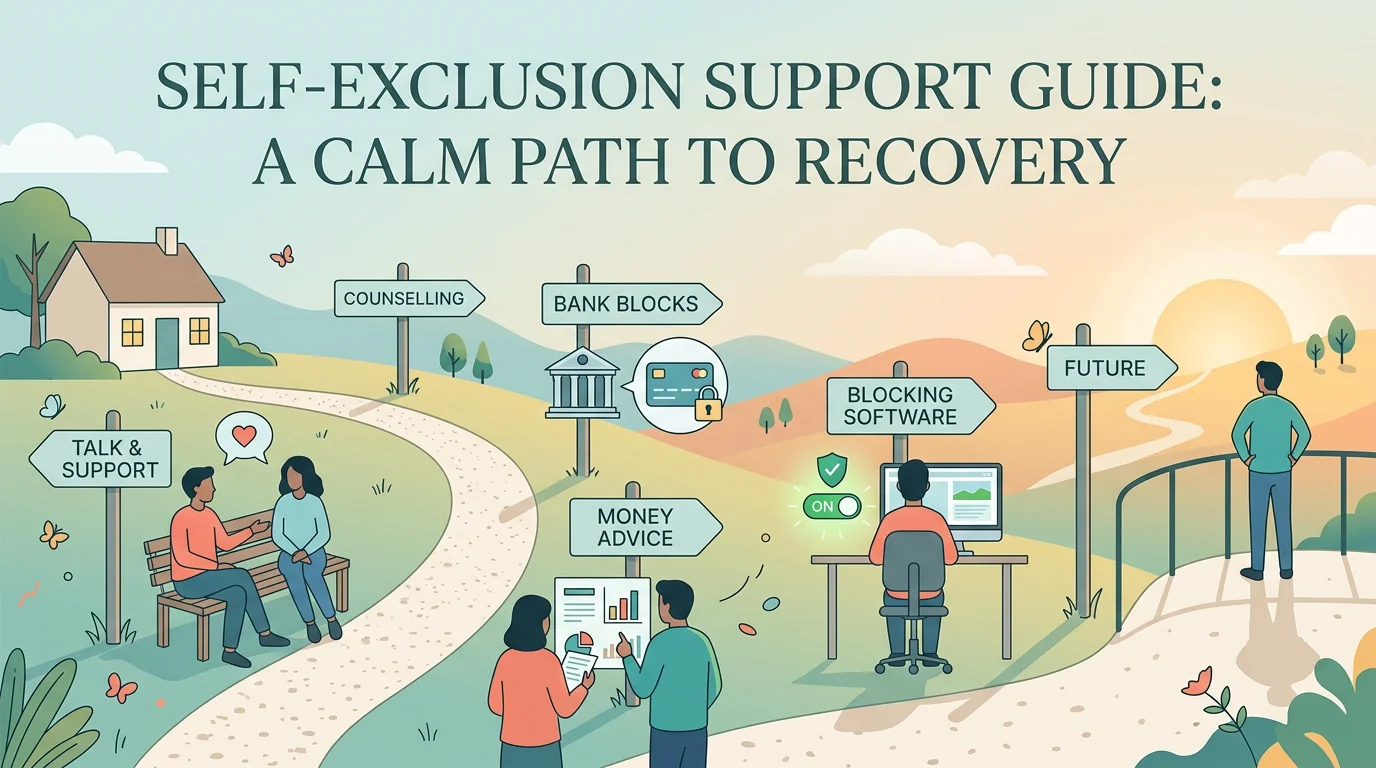
Main Features of UK GamStop Self-Exclusion Tools
GAMSTOP is a self-exclusion scheme for online gambling companies licensed in Great Britain. Its public information explains that it blocks access to online accounts with those licensed companies and that a registration cannot be cancelled during the chosen exclusion period. That is the most important starting point. The exclusion is not a minor account setting. It is a protective decision that should continue to do its job when gambling starts to feel tempting again.
When someone is drawn to a casino outside GAMSTOP, it can look like a simple account choice. Underneath, the situation can be more personal: a strong urge to gamble, frustration with blocks, pressure to recover losses, debt stress, boredom, shame, or the feeling that one more deposit will settle things. Those feelings do not make someone weak. They do mean that practical barriers and human support matter more than another gambling account.
This guide focuses on protective next steps. It does not suggest ways to get around self-exclusion, bank blocks, identity checks, device blocks or operator restrictions. Those barriers exist because gambling can become difficult to control. If a barrier is frustrating today, it may also be doing exactly what you needed it to do when you set it up.
Decision path for the moment you are in
| What is happening | Safer next step | Why this helps | What to avoid |
|---|---|---|---|
| You want to gamble while self-excluded | Leave the gambling site, keep GAMSTOP in place, and move to a support action such as GamCare, GambleAware or a trusted person. | The urge is time-sensitive. A protective delay can stop a deposit before it happens. | Do not look for sites promoted as outside GAMSTOP or for ways to bypass blocks. |
| You need stronger barriers | Add bank gambling blocks and blocking software alongside self-exclusion. | Layered barriers reduce the number of easy routes back to gambling. | Do not rely on willpower alone when a practical block can slow the decision down. |
| You are worried about gambling debt | Use MoneyHelper debt guidance and consider speaking to a debt adviser or support service. | Debt pressure can drive more gambling, so separating money help from gambling urges is useful. | Do not treat another deposit as a debt plan. |
| You need someone to talk to | Use GamCare or GambleAware routes, and read NHS information on gambling harms if health or wellbeing is affected. | Talking to someone can reduce isolation and help you choose a safer immediate step. | Do not wait for the problem to feel severe enough before asking for help. |
Layering protection: GAMSTOP, bank blocks and blocking software
Self-exclusion is strongest when it is not the only barrier. GamCare explains that bank gambling blocks are free tools offered by most UK banks to block transactions categorised as gambling. They are normally applied at card level and are best layered with self-exclusion and blocking software. That combination is practical because different urges use different routes. One day the problem may be an online account. Another day it may be a payment card, a late-night device or a marketing message.
A bank block does not treat the reasons gambling has become difficult, and it may not cover every possible payment path. It is still useful because it creates friction at the point where money would leave the account. Blocking software adds another layer by making gambling sites harder to access on devices. Neither tool has to be perfect to be worthwhile. Their purpose is to interrupt the fast decision that often happens before a person has had time to think.
It can also help to update account details connected to self-exclusion and support tools so that protection follows current information. If you move, change a phone number, change email addresses or use a new card, check whether the protection tools you rely on still have the information they need. This is a practical maintenance step, not a sign that the original decision failed.
Support options you can use without a sales pitch
Verified public support routes include GamCare and the National Gambling Helpline, GambleAware, NHS information on gambling addiction and support, and MoneyHelper guidance on gambling and debt. Each has a different role. GamCare and GambleAware are useful starting points for gambling-specific support. NHS information can help when gambling is affecting health and wellbeing. MoneyHelper is useful when debt pressure is part of the problem.
Use these routes in a way that fits the moment. If you are seconds away from depositing, the first step may simply be to close the gambling site and open a support page. If debt pressure is driving the urge, the first step may be to separate the debt problem from the gambling impulse and read money guidance before making any new financial decision. If you feel embarrassed, remember that these services exist because gambling harm is common enough to need structured help. You are not the only person who has needed a barrier to hold.
Do not rely on phone details copied from old pages or third-party posts. If you want to call or chat, use the current contact options shown on the official service page you open. That keeps the practical information current without depending on copied numbers.
What regulated operators are expected to do
Licensed gambling businesses in Great Britain operate within rules that include safer gambling expectations. One confirmed change from 31 October 2025 is that gambling businesses must prompt customers to set a financial limit before first deposit and make it easy to review or alter that limit after that. A financial limit is not the same as self-exclusion, but it is another example of a barrier designed to slow harm and make spending more visible.
For a self-excluded person, the important point is not to compare which commercial site offers the most flexible limits. The important point is that protective tools are part of regulated gambling for a reason. If a website’s attraction is that it appears to avoid those tools, the attraction itself is a warning sign. A safer response is to use support and protection rather than to treat the absence of protection as a benefit.
A simple plan for a difficult hour
- Stop the immediate route. Close the gambling tab or app. Do not test whether a block still works.
- Add friction. Turn on a bank gambling block if your bank offers one, and use blocking software where it helps.
- Move money decisions away from the urge. If debt or bills are part of the pressure, use MoneyHelper guidance rather than a deposit.
- Use a support route. Open GamCare, GambleAware or NHS information and choose the current contact option shown there.
- Tell one safe person if you can. A trusted person can help you get through the immediate urge and keep protective tools in place.
This plan is not a cure and it does not replace professional help. It is a way to get through the moment without turning a temporary urge into a new account, new deposit or new debt.
Difficult moments and safer answers
Can I cancel GAMSTOP during my exclusion period?
GAMSTOP says the chosen exclusion period cannot be cancelled during that period. If that feels difficult, treat the feeling as a signal to use support and extra barriers rather than a reason to look for another gambling route.
Are bank gambling blocks enough on their own?
No single tool should be treated as enough for every person. Bank blocks can be useful, especially when layered with self-exclusion, blocking software and support.
What if I am not sure whether my gambling is a problem?
You do not need to wait for certainty before using safer tools. If gambling feels hard to control, if debt is growing, or if blocks feel tempting to bypass, support services are a sensible starting point.
Created by the "Casino not on Gamstop" editorial team.